Elevate your beverage business with unbeatable glycol chiller deals


 Sign In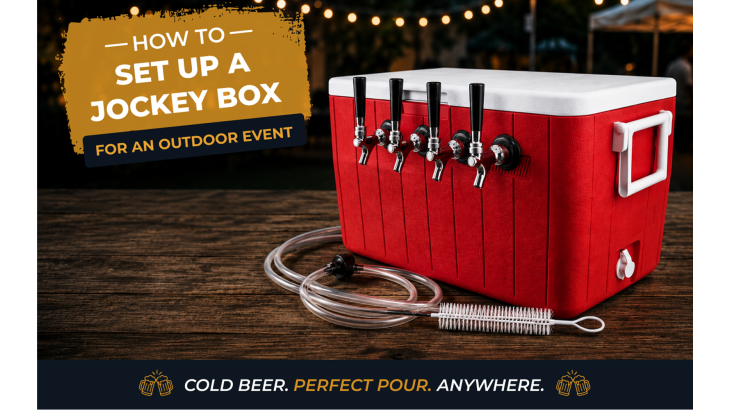
Jul 30 2026
358
Step-by-step guide to setting up a jockey box: coil length, CO₂ pressure, ice ratios, and common mistakes. Everything you need for a perfect outdoor draft beer setup.
How to Set Up a Jockey Box for an Outdoor Event: Step-by-Step Guide
When you need to serve cold draft beer at an outdoor event — a festival, a corporate party, a wedding, or a stadium tailgate — a jockey box is the most reliable solution available without permanent infrastructure. Unlike kegerators or glycol chiller systems, a jockey box requires no electricity, no fixed installation, and no long setup window. You fill it with ice, connect a CO₂ tank, tap the keg, and you’re pouring within minutes.
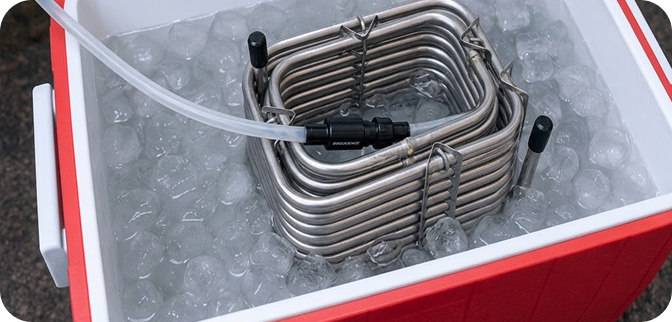
A jockey box is a portable draft beer dispenser built around an insulated cooler. Inside runs a stainless steel coil or cold plate submerged in ice — as beer travels through, it drops to serving temperature before reaching the faucet. The result: properly chilled draft beer anywhere you need it, with no power access required. The setup is straightforward, but the details matter: coil length, CO₂ pressure, and line connections all directly affect pour quality.
KEY TAKEAWAYS

A jockey box cools beer through a stainless steel coil or cold plate submerged in ice — no electricity required.

Coil length determines cooling capacity: a 120-foot coil is the industry standard for most outdoor events.

CO₂ pressure for a jockey box runs higher than a standard draft system — between 20 and 30 PSI — due to coil resistance.

Always pre-chill your keg to 36–38°F for a minimum of 24 hours before the event.

Jockey boxes are available in 1–4 faucet configurations. Browse UBC’s full jockey box lineup to match faucet count to your event size.

A single-faucet box with a 120-foot coil serves approximately 1–2 half-barrel kegs per ice fill.

Ice quantity is critical: fill the cooler completely and add water to create a true ice bath.
What You’ll Need Before You Start
Before you connect a single line, confirm every component is on-site and working. Missing one piece mid-event is not a recoverable situation. For a complete equipment list including CO₂ regulators and keg couplers, refer to the table below.
Item |
Minimum Spec |
Notes |
|---|---|---|
| Jockey Box | 1–4 faucets | Match faucet count to product variety |
| CO₂ Tank | 5 lbs | 10 lbs recommended for 2+ kegs |
| CO₂ Regulator | Primary with gauge | One per gas source |
| Keg Coupler | Match to keg type | D-type for most US domestic beers |
| Beer Line | 3/16" ID vinyl tubing | Affects resistance and pressure |
| Ice | Fill cooler completely | Add water to create ice bath |
| Keg Temp Before Tap | 36–38°F | Pre-chill minimum 24 hours |
| Drip Tray | 1 per faucet | Essential for outdoor events |
| Sanitizing Solution | Food-grade | Run through coil before every use |
Step-by-Step Setup Guide
Follow these steps in order. Each step builds on the previous one — skipping ahead is a common cause of foam problems.
Step 1: Inspect and Sanitize
Before anything else, run a sanitizing solution through the coil using a hand pump or gravity feed — do not skip this even if the box was cleaned after last use. Check faucets for worn washers or corrosion. A contaminated coil affects flavor and foam regardless of pressure settings. For compatible cleaning supplies, see UBC’s beer line cleaning accessories.
Step 2: Pack the Cooler with Ice
Fill the cooler completely with ice, then add cold water to create a true ice bath. Target ice bath temperature: 29–32°F. Water-to-ice ratio: approximately 20% water, 80% ice by volume. Do not use warm water — it accelerates melt and raises bath temperature before service begins.
Step 2: Pack the Cooler with Ice
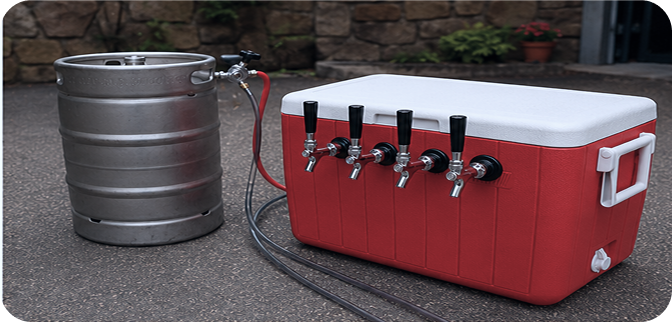
Place the pre-chilled keg within 10 feet of the jockey box — shorter beer line means less resistance and heat gain. Keep the keg shaded and off hot pavement. Use a keg blanket or tarp if direct sun exposure is unavoidable.
Step 4: Attach the Keg Coupler
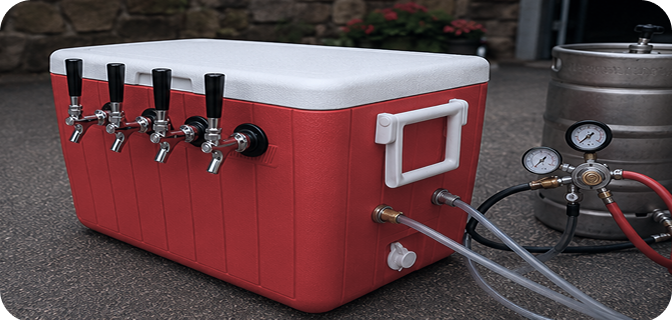
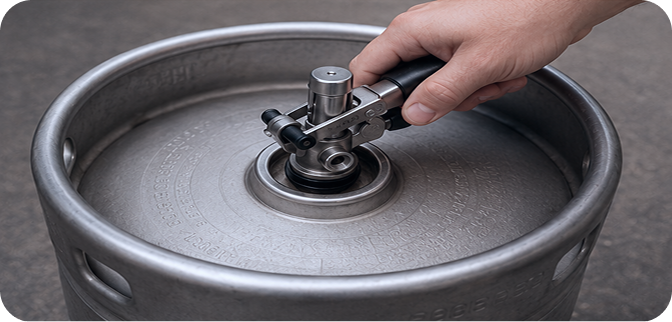
Verify the correct coupler type before connecting. Align the probe with the keg valve, press down, and rotate clockwise until locked. Do not connect the gas line yet.
Coupler Type |
Common Application |
|---|---|
| D (American Sankey) | Most US domestic beers — Budweiser, Coors, Miller |
| S (European Sankey) | Heineken, Stella Artois, most European lagers |
| A (German Slider) | Paulaner, Spaten, some German imports |
| G (Irish/British) | Guinness, Bass |
| M (Party Star) | Some European imports |
Step 5: Connect the Beer Line
Run 3/16" ID vinyl tubing from the coupler outlet to the jockey box inlet. Secure both ends with clamps — finger-tight is not sufficient. Keep the line as short and straight as possible; coiling excess or letting it rest in direct sun adds resistance and heat.
Step 6: Connect the CO₂ Regulator
Attach the primary regulator to the CO₂ tank. Set to 0 PSI before opening the valve. Open slowly — a quarter turn is sufficient. The supply gauge should read 800–900 PSI for a full 10 lb tank. Then adjust delivery pressure to 20–25 PSI as a starting point (see CO₂ Pressure section below).
Step 7: Open the Coupler and Test the Pour
Open the keg coupler and wait 60 seconds for pressure to equalize. Pull the faucet fully open and discard the first 8–12 oz — it will contain air pockets and sanitizer. A properly set up box should deliver beer at 35–40°F with a clean 1-inch head on a 16 oz pour.
Step 8: Monitor During Service
- Ice level — replenish before bath temperature rises above 35°F.
- CO₂ supply gauge — replace tank before it drops below 200 PSI.
- Pour quality— sudden foam means check ice first, then pressure, then line connections.
How to Calculate the Right Coil Length
Coil length is the single most important variable in jockey box setup. The industry benchmark is 1 foot of coil per 1°F of temperature drop required. For most outdoor events in North America, a 120-foot stainless steel coil is the practical standard. UBC’s jockey boxes are available with coil configurations matched to every event size.
Event Type |
Expected Pour Rate |
Recommended Coil |
|---|---|---|
| Small private party (under 50 guests) | Low (1–2 pours/min) | 50–75 ft |
| Medium outdoor event (50–200 guests) | Moderate (2–4 pours/min) | 120 ft |
| Festival or large venue (200+ guests) | High (4–8 pours/min) | 120 ft per faucet |
| Multi-day event, warm climate | High + sustained | 120 ft + cold plate combo |
| Corporate or branded event | Moderate | 120 ft, 2–4 faucet box |
Feature |
Stainless Steel Coil |
Cold Plate |
|---|---|---|
| Cooling capacity | High | Moderate |
| Performance in heat (80°F+) | Strong | Degrades faster |
| High pour rate performance | Excellent | Adequate at low volumes |
| Best for | Festivals, large events | Small parties, mild weather |
| Maintenance | Easy to flush and clean | More difficult to sanitize |
CO₂ Pressure Settings: Getting It Right
A standard bar draft system runs at 10–14 PSI. A jockey box requires significantly more — every foot of 3/16" beer line generates approximately 0.5 PSI of resistance, so a 120-foot coil needs 20–30 PSI at the regulator just to maintain a normal pour rate. Use the table below as your starting point, then adjust in 2 PSI increments only.
Coil Length |
Starting Pressure |
Adjust If |
|---|---|---|
| 50 ft | 12–16 PSI | Foam: −2 PSI | Slow pour: +2 PSI |
| 75 ft | 16–20 PSI | Foam: −2 PSI | Slow pour: +2 PSI |
| 120 ft | 20–28 PSI | Foam: −2 PSI | Slow pour: +2 PSI |
| 120 ft, warm (85°F+) | 25–30 PSI | Monitor ice bath closely |
| Cold plate | 10–14 PSI | Similar to standard draft system |
Key rule: when foam appears mid-service, replenish ice first — a warm bath is almost always the root cause, not pressure. For every 5°F rise in ice bath temperature above 32°F, expect pour quality to degrade noticeably.
CO₂ Tank Size |
Kegs Served (Approximate) |
|---|---|
| 2.5 lbs | 1 half-barrel (15.5 gal) |
| 5 lbs | 2–3 half-barrels |
| 10 lbs | 5–6 half-barrels |
| 20 lbs | 10–12 half-barrels |
Common Mistakes to Avoid

Using a Warm Keg: the single most common cause of foam. A warm keg forces the coil to drop temperature by 20°F+ instead of the standard 2–5°F — no pressure setting compensates for this. Store all kegs at 36–38°F for at least 24 hours before the event.

Underpacking Ice: a half-filled cooler means the coil is only partially submerged. The effective coil length drops by whatever percentage is above the ice line. Fill completely, add water to create a true bath, and plan to replenish every 2–3 hours during summer events.

Setting CO₂ Pressure Too Low: operators familiar with bar systems set pressure at 10–14 PSI — which produces an unusably slow pour on a 120-foot coil. Start at 20–25 PSI and adjust in 2 PSI increments. Keep a spare CO₂ regulator on-site and always bring a larger tank than you calculate.

Skipping Sanitation: a jockey box stored between events accumulates bacteria and yeast residue. Always run sanitizing solution through the coil before connecting to a keg, and flush again after the event before storage. See UBC’s cleaning equipment for compatible line cleaners and hand pumps.
Final Thoughts
A jockey box is one of the most practical pieces of draft beer equipment for outdoor and temporary service — but only when set up correctly. The variables that determine success are not complicated: a pre-chilled keg, a full ice bath, the right coil length, and CO₂ pressure dialed in before the first guest arrives.
The mistakes that derail outdoor events are almost always avoidable. Warm kegs, underpacked coolers, incorrect pressure, and skipped sanitation are preparation failures — not equipment failures. This guide gives you everything you need to avoid them.
If you are evaluating equipment for purchase or recurring use, match coil length, faucet count, and cooler capacity to your expected volume. A 120-foot coil in a 2- or 4-faucet configuration covers the majority of outdoor scenarios. For branded events, a customized jockey box with your logo delivers the same performance with a significantly stronger visual presence at the venue.

Frequently Asked Questions
A 5 lb tank is the minimum for a single half-barrel keg (15.5 gal). As a rule, one pound of CO₂ serves approximately 1.5–2 half-barrel kegs at 20–28 PSI. For multi-keg events, use a 10 lb tank and bring a spare. Browse CO₂ regulators and tank accessories at UBC.
Under typical summer conditions (75–85°F), a fully packed ice bath lasts 2–3 hours before replenishment. In extreme heat (90°F+) or under high pour volume, this shortens to 90 minutes or less. A 120-quart cooler requires approximately 20–25 lbs of additional ice per replenishment cycle.
The Brewers Association standard is 35–38°F at the faucet. American lagers are best at 35–36°F; craft ales and IPAs can go slightly warmer (38–45°F) to allow aromatics to express. A properly set up jockey box with a pre-chilled keg should stay within this range throughout the event.
Yes. Any beverage that can be kegged and dispensed under gas pressure can be served through a jockey box. For wine and cider, use a nitrogen/CO₂ blend to avoid overcarbonating. For still beverages like cold brew or pre-batched cocktails, use pure nitrogen at 5–10 PSI.
The right number of faucets depends on your guest count. For under 75 guests, 1 faucet is typically enough. For 75–150 guests, plan for 2 faucets. For 150–300 guests, 3–4 faucets keeps lines moving. Beyond 300 guests, it's best to run multiple jockey boxes rather than adding faucets to a single unit. If you are serving more than one beer style, add one faucet per additional product. See UBC's multi-faucet jockey box options to find the right configuration.
Flush immediately after the event — do not leave beer residue overnight. Sequence: disconnect keg and CO₂ → flush with clean water until clear → run beer line cleaning solution through coil → soak per manufacturer instructions → flush again with clean water → store with faucets open. Deep-clean with a recirculating pump after every 3–5 uses.
A kegerator is a refrigerated unit that chills the keg itself using a compressor. It requires a power source and permanent placement. A jockey box uses ice to chill beer as it flows through the coil, requires no electricity, and is operational within minutes. Kegerators suit permanent bar installations; jockey boxes are the correct choice for outdoor events, festivals, and temporary service.
Contact Us today so our sales team answer all your questions and prepare a quote tailored to your needs.