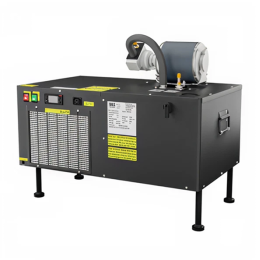
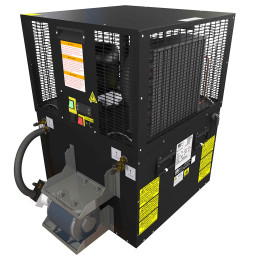
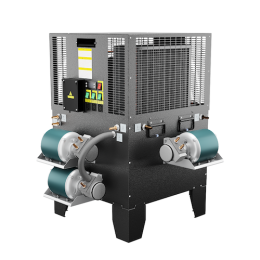
Elevate your beverage business with unbeatable glycol chiller deals


Choose the right power pack for your beer system by calculating its total BTU (British Thermal Unit) load. A power pack’s BTU rating shows how much heat it can remove from the system while circulating glycol.
Every beer system places a specific BTU demand on the power pack. If that demand goes above 60% of the unit’s rated BTU capacity, the compressor will have to run longer to keep the glycol bath at the proper temperature. This overworks the compressor and reduces the lifespan of the power pack.
The goal is to balance compressor operation—achieving run times and rest times that are as equal as possible. Use our quick calculator to determine the most efficient power pack for your setup.
When sizing a glycol power pack, bigger isn’t always better.
For most draft beer systems, the goal is to operate your glycol chiller at no more than 60% load during peak conditions. This ensures stable line temperature, faster pull-down, and extended compressor life.
General guidelines:
Tip: You can cross-reference your calculated BTU with our Glycol Power Packs page to find the ideal unit for your setup.
The trunk line diameter and insulation directly affect BTU demand.
Use the table below as a general guide for draft beer systems:
| Beer Line Size (ID) | Max Recommended Run | Typical BTU per Foot |
|---|---|---|
| 1/4" | up to 50 ft | 45–55 BTU/ft |
| 5/16" | up to 125 ft | 50–60 BTU/ft |
| 3/8" | up to 750 ft | 55–65 BTU/ft |
Insulation Tips:
For more installation accessories, see our Trunk Line Collection and Installation & Maintenance Tools.
Breweries, cideries, and wineries can also estimate glycol chiller size using the same BTU principle.
In fermentation and crash cooling, heat load depends on vessel volume, temperature change (ΔT), and cooling time.
Example:
A 7-barrel (217 gal) fermenter cooled from 68°F to 34°F in 2 hours ≈ 12,000 BTU/hr load.
Multiply by the number of active tanks, add 15% safety margin, and compare against the power pack’s total capacity.
For large-scale systems, refer to Glycol Chillers for Breweries or contact our team for custom load charts.
The required BTU per foot of trunk line depends on line diameter, insulation quality, and ambient temperature.
For most glycol-cooled draft systems, use 45–65 BTUs per foot as a practical design range. Smaller lines (¼") need slightly less, while longer 3/8" lines require more cooling energy due to increased surface area and flow resistance.
Poor insulation or hot ambient conditions can raise heat gain significantly — sometimes up to 80 BTU/ft. Always design using the worst-case load and a 10–15% safety margin to keep your chiller running efficiently.
Always calculate BTU demand for your highest expected room or ceiling temperature.
In most bars or restaurants, ambient temperature ranges from 85°F to 95°F, but ceiling voids and outdoor runs can exceed 100°F. Designing for those peaks prevents beer from warming during long pulls or rush periods.
If your glycol chiller sits in a hot mechanical room, its condenser may need additional ventilation or upgraded capacity.
A simple rule: every 10°F increase above 80°F adds about 15–20% extra BTU load.
The 60% load rule is the sweet spot for glycol chiller sizing.
Running a chiller at 100% all day shortens compressor life, increases wear, and leads to inconsistent beer temperature.
Operating around 60% capacity ensures the system can handle sudden demand spikes (busy nights, summer heat) without stress.
Oversizing is also a mistake — if the chiller is too large, it short-cycles, the glycol bath stratifies, and cooling becomes uneven.
Aim for 55–65% steady-state load and let the remaining capacity absorb ambient or expansion factors.
Yes — your glycol concentration directly impacts heat transfer and BTU efficiency.
A 40% propylene glycol mix offers ideal cooling and freeze protection down to 25°F.
Going higher (35–40%) improves freeze protection but slightly reduces heat transfer efficiency — your chiller may need more run time or capacity to maintain the same line temperature.
For beer systems, use food-grade propylene glycol only and check concentration with a refractometer seasonally.
Balanced mix = efficient cooling, consistent pour, and longer pump life.
See our Propylene Glycol & Accessories for ready-to-use blends.
Yes, a single power pack can cool multiple towers — if it's properly sized.
Add up the total BTU load for all lines and faucets, including return runs, and ensure it stays below the rated BTU/hr capacity of the chiller.
For example, a 7,500 BTU/hr unit might support 12 faucets on 75 ft lines, while a 12,000 BTU/hr chiller could serve 16+ faucets across longer runs.
If towers are at different distances, use balancing valves or flow restrictors to equalize temperature.
Always size for the combined load, not per tower — the glycol loop is one continuous circuit.
Beer line cooling is about maintaining temperature in small tubing, while brewery glycol systems often pull down large volumes of liquid quickly.
Fermenters, brite tanks, and crash-cooling vessels have dynamic heat loads — thousands of BTUs per hour — versus hundreds in draft lines.
That's why brewery chillers often use multi-stage compressors or reservoir tanks to buffer thermal shock.
If your chiller doubles for fermentation cooling, calculate each vessel's load (using ΔT × volume × specific heat) and sum them up with your draft system load.
For most long-draw draft beer systems, the glycol bath should stay between 28°F and 32°F.
This keeps beer lines near 36–38°F — the perfect dispense temperature.
Lower temperatures (below 26°F) risk freezing glycol or causing line frost, especially with high glycol concentrations.
Monitor bath temperature and glycol level weekly, and clean the reservoir quarterly to remove scale or biofilm.
Stable glycol temperature = consistent pours and reduced system stress.


 Sign In